
When I went back to work after maternity leave, I quickly found that my brain had less room to come up with ideas on the spot.
Between all my tasks at work, plus keeping up with the new logistics routine of childcare, drop-offs, pick-ups, packed lunches and spare clothes bags, there didn’t seem to be much room in my head for processing anything else.
Consequently the ‘small stuff’ became big and too hard for my brain to grasp.
For instance, conversations about what to cook my child for dinner often went like this:
“What shall we cook him for dinner tonight?”
“Erm, what did he have last night?”
“Was it pasta?”
“Not that was the day before wasn’t it?”
“Either way he probably can’t have that again today then…”
“Ok so what shall we do him today?”
“Is he having fish fingers with nanny and grandad tomorrow?”
“Maybe double check with them…”
My brain just was not good at finding answers in a hurry. My brain copes better when there is a plan – but even if there was a plan, remembering it was also hard! Especially as I was still up in the night-time feeding my son for the first 8 months of being back at work, so I was tired AF. Brains don’t tend to work well on tiredness. Plan or no.
I realised that a lot of the Juggle Struggle was going on in my brain, as that’s where I was mainly juggling all the information.
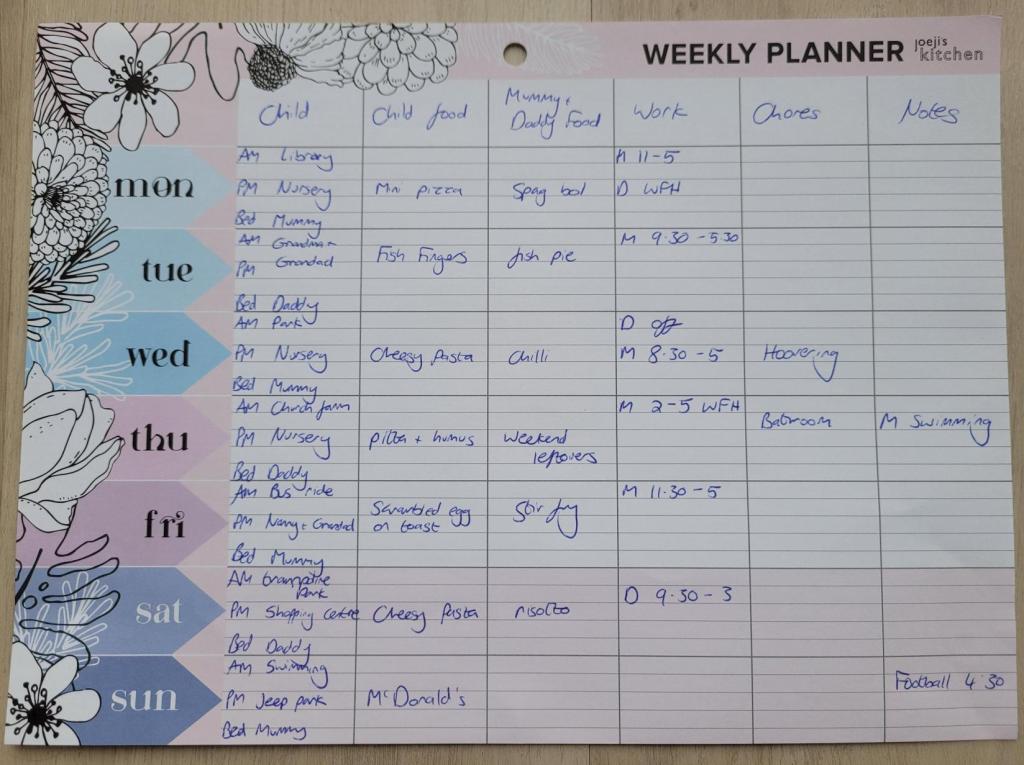
So to try and give my brain a rest, I started a routine of mapping out my week on one page – keeping it on the kitchen table in easy view for the whole week.
If you don’t do something like this I can’t recommend it enough for your juggle struggle.
Here’s an example* of mine:
(I got it from Amazon here:https://www.amazon.co.uk/dp/B08DHJ98X2?psc=1&ref=ppx_yo2ov_dt_b_product_details )
*Disclaimer number 1 – this is just an example – in real life my handwriting was never this neat but I wanted to give you half a chance of reading it.
*Disclaimer number 2 – this also started life as a whiteboard, but once my toddler discovered said whiteboard and pens and magnets, that was pretty much game over.
I’d take 15 minutes at the weekend to plot out all the logistics of the week onto this one view – I like it because the different columns let me keep track of all the different moving parts of life, which so often impact each other:
Childcare / child entertainment
We were lucky enough to have grandparent help with childcare alongside some nursery afternoons.
Outside of this, I liked to have a plan for what I was roughly going to do with my 2 year old, even if that was just a quick trip out on the bus (which he used to really love!).
Sometimes hours with toddlers seem to stretch out into infinity, and if I had to come up with activity ideas on the spot I always felt a bit like a rabbit in the headlights.
Often I’d end up changing the plans that I had written down, but just having something on paper in the first place rather than a blank canvas of endless time seemed to help me come up with ideas.
Bedtimes
My husband and I like to take it in turns to put our son to bed, but sometimes that obviously needs to chop and change around.
Keeping track of that in my head was another thing making me feel exhausted. Writing it down let me forget about it and think about other things.
Food
Not everyone’s on board with meal planning and I totally get that. How do you know what you’re going to want to eat tomorrow let alone in 5 days time? Food is pretty important to my husband, so meal planning is just something we’ve always done.
Our toddler was a VERY fussy eater, so we only had a few dinner options that we had to rotate.
I found it much easier to cope with planning out the toddler dinners in advance rather than trying to come up with inspiration each day – especially as trying to get him to eat new foods was always a soul-destroying failure. Having a backup written down in black and white was very reassuring.
Work
Going back to work after maternity leave and trying to shoehorn 30 hours around the childcare windows we had available meant that I ended up working different hours most days.
My husband never really knew whether I was coming or going, so writing it all down helped us both figure out where we were supposed to be, and whether there were any challenges like late meetings to plan for.
Chores
Parents everywhere will know this story: Once upon a time our house (before kids) was lovely and tidy and clean. Our house with a toddler was not that.
Rather than kill myself trying to have a clean house all in one go, I spent 20 minutes here and there cleaning pockets of it at a time.
Writing that down also made the small chunks seem manageable, and made me worry less about ‘the state of the house’. I knew I’d get to the next small chunk next time.
Notes
Sometimes there were other things to keep track of, like a birthday, or a night out with the girls (gasp!). Having a visible reminder of those things alongside all the rest made it easy to see if other things needed to shift and change.
Once I got into the routine of plotting the week on a page, I got pretty quick at doing it, and it was so worth the effort.
Instead of coming home from work and thinking “URGH what am I cooking the picky toddler for dinner tonight?” I would just look at the week planner and cook whatever was on there, stress-free.
Instead of waking up feeling like a zombie after a very interrupted night’s sleep and wondering how on earth I was going to entertain the toddler, I would just look at the week planner – no thought involved.
My brain felt more relaxed, and I could almost let myself feel like I was winning the juggle struggle a bit.
How do you plan your week? Do you keep the plan in full view of everyone?
I’m such an organisation nerd so send me some pics of your whiteboards, planners and diaries and post your tips in the comments below. I’d love to see them!
If you don’t put your week on a page – try it this week. Email me at juggle.struggle1234@gmail.com and tell me if it helps!
 Juggle Struggle blog